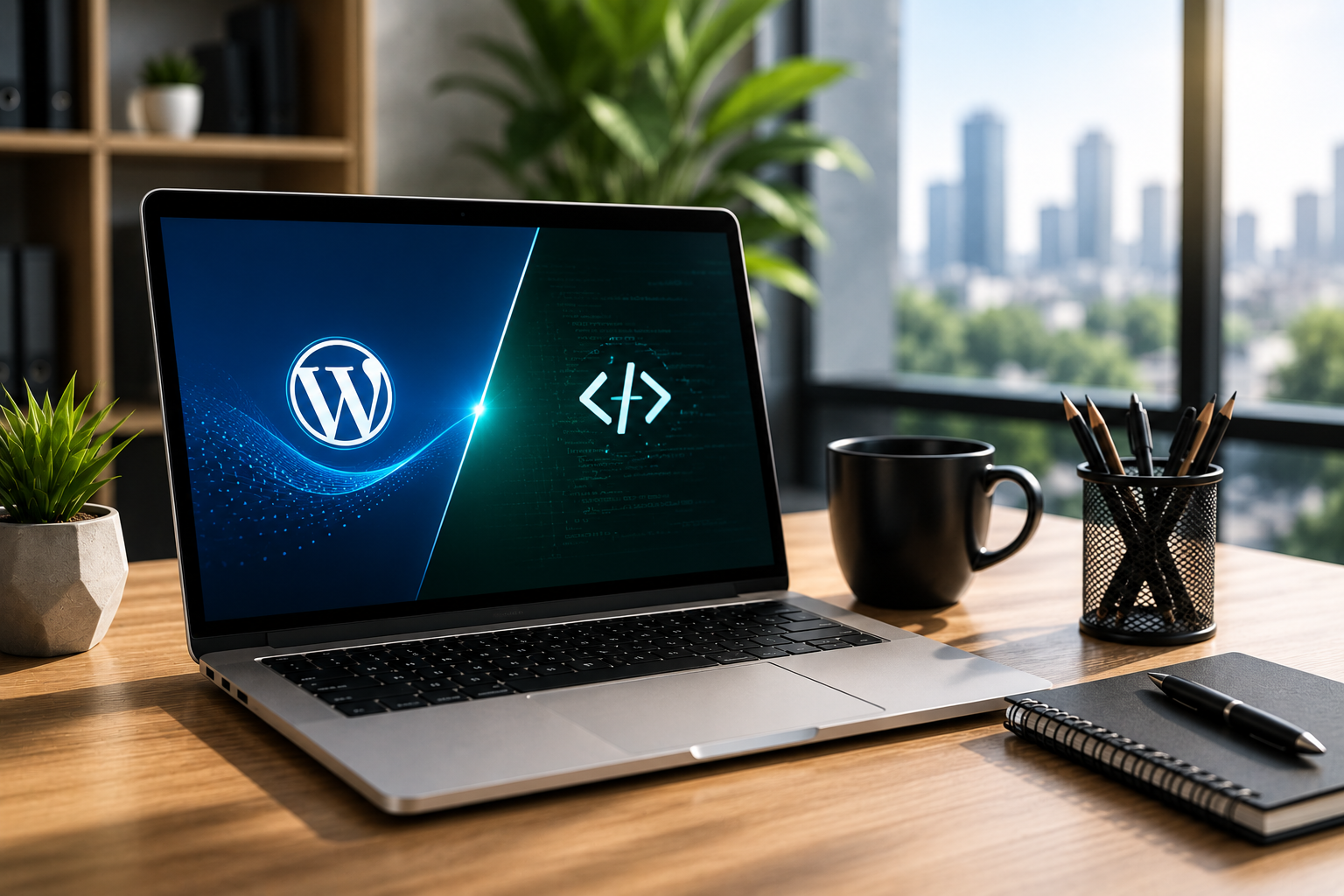
WordPress Website vs Custom Website – Which One Is Better?
When planning a new website for your business, one of the most important decisions you will face is whether to build it with WordPress or develop it as a fully custom website. Both options can create professional, high-performing websites, but they are designed for different needs, budgets, and business goals. That is why many business owners ask the same question: WordPress website vs custom website – which one is better?
The answer depends on what kind of website you need, how much flexibility you want, how complex your features are, and how much you are ready to invest in development and long-term maintenance. For some businesses, WordPress is the smartest, fastest, and most cost-effective solution. For others, a custom-built website offers better performance, scalability, and freedom.
In this guide, we will compare WordPress websites and custom websites in detail, including their differences, advantages, disadvantages, costs, SEO potential, scalability, maintenance, and ideal use cases. By the end, you will have a clear understanding of which option is the right fit for your business.
What Is a WordPress Website?
WordPress is one of the most popular website platforms in the world. It is a content management system (CMS) that allows businesses to build and manage websites without creating every function from scratch. With WordPress, developers can use themes, plugins, page builders, and custom coding to create a wide variety of websites, including business websites, blogs, portfolios, eCommerce stores, booking sites, and more.
WordPress is widely used because it is flexible, user-friendly, cost-effective, and easy to manage. It allows businesses to launch websites faster while still offering plenty of customization options.
Common types of websites built with WordPress:
- Business websites
- Corporate websites
- Blogs and news portals
- Portfolio websites
- eCommerce websites using WooCommerce
- Educational or course websites
- Landing pages and lead generation sites
What Is a Custom Website?
A custom website is built from the ground up using programming languages, frameworks, and custom logic rather than relying on a pre-built CMS structure. It is specifically designed and developed to match the exact requirements of a business.
Custom websites can be built using technologies such as HTML, CSS, JavaScript, PHP, Laravel, React, Next.js, Node.js, Python frameworks, or other modern development stacks. Instead of depending on ready-made themes and plugins, a custom website gives developers full control over the design, functionality, performance, and backend architecture.
This approach is often chosen for websites or web applications that need unique features, advanced integrations, custom workflows, or very specific performance and security requirements.
WordPress Website vs Custom Website: The Core Difference
The main difference between a WordPress website and a custom website is how they are built and managed.
- WordPress website: Built on top of an existing CMS platform using themes, plugins, and optional custom development.
- Custom website: Built entirely from scratch or from a custom development framework based on the business’s exact requirements.
WordPress provides a faster and more affordable path to launching a website, while custom development offers maximum flexibility and control.
1. Development Time: Which One Is Faster?
WordPress Website
WordPress is usually much faster to build because the core system, dashboard, plugin ecosystem, and theme structure already exist. Developers can customize a theme, install necessary plugins, create pages, and launch the website in a relatively short time.
For many business websites, a professional WordPress site can be completed much faster than a fully custom solution. This makes it ideal for companies that want to launch quickly.
Custom Website
Custom websites take longer because everything must be planned, designed, and developed from the ground up. Even if a framework is used, the project often involves custom database structures, feature development, testing, optimization, and deployment.
If your project requires advanced features, custom user roles, unique workflows, or a web application structure, the longer development time may be worth it.
Winner for speed: WordPress
If speed-to-launch is a major priority, WordPress usually wins.
2. Cost: Which Option Is More Budget-Friendly?
WordPress Website
WordPress websites are generally more affordable because they use an existing CMS foundation. Development time is shorter, and many features can be added through plugins instead of being built from scratch.
For startups, small businesses, local service providers, and companies with moderate requirements, WordPress can provide excellent value for money.
Custom Website
Custom websites usually cost more because they require more development hours, more planning, more testing, and often a higher level of technical expertise. If the website includes complex dashboards, custom workflows, API integrations, or application-like features, the cost increases further.
However, for businesses that need something highly specialized, the extra cost can be justified.
Winner for affordability: WordPress
If you want a professional website on a lower budget, WordPress is usually the better option.
3. Flexibility and Customization
WordPress Website
WordPress is highly flexible, especially when developed by experienced professionals. It supports custom themes, custom plugins, custom post types, advanced page layouts, and third-party integrations. However, it still operates within the structure of the WordPress ecosystem.
That means some highly unique features may require workarounds, heavy plugin usage, or deeper custom development inside WordPress.
Custom Website
Custom websites offer the highest level of flexibility because there are no platform limitations. Developers can create the exact structure, feature set, user flow, and backend logic the business needs. This makes custom development ideal for businesses that require very specific functionality.
Winner for flexibility: Custom Website
If your project has highly unique requirements, a custom website offers more freedom.
4. Ease of Content Management
WordPress Website
One of WordPress’s biggest strengths is content management. It was originally built as a publishing platform, and it still excels at making content easy to update. Business owners can usually edit pages, upload blog posts, update images, change text, and manage products without needing technical knowledge.
This makes WordPress an excellent option for businesses that want to manage content regularly.
Custom Website
With a custom website, content management depends entirely on how the site is built. If the developer creates a custom admin panel or integrates a headless CMS, content updates can still be smooth. However, this often requires extra development effort and cost.
Without a good admin system, updating a custom website may be more difficult than updating a WordPress site.
Winner for content management: WordPress
For non-technical teams and regular content updates, WordPress is usually easier to manage.
5. SEO Potential
Both WordPress and custom websites can perform very well in search engines if they are built properly. SEO depends more on site structure, speed, content quality, metadata, internal linking, mobile responsiveness, and technical optimization than on the platform itself.
WordPress Website
WordPress is SEO-friendly and offers many SEO plugins and tools that make optimization easier. It is especially useful for businesses that want to publish blog content regularly and manage on-page SEO without technical complexity.
Custom Website
Custom websites can also be highly SEO-friendly, and in some cases, they can be even more optimized because developers have full control over every technical detail. However, the SEO setup must be built correctly from the beginning.
Winner for SEO: Tie
Both can perform extremely well if developed and optimized correctly.
6. Performance and Speed
WordPress Website
A well-built WordPress website can be fast, but performance depends heavily on hosting quality, theme quality, plugin usage, image optimization, caching, and overall development quality. Poorly built WordPress sites with too many plugins often become slow.
Custom Website
Custom websites can be extremely fast because they can be built with only the features needed—nothing extra. Developers can optimize code, assets, database queries, and server architecture specifically for performance.
Winner for maximum performance: Custom Website
If raw performance optimization is a top priority, custom development has an advantage.
7. Scalability for Future Growth
WordPress Website
WordPress can scale surprisingly well for many businesses, especially content-driven sites, business websites, and moderate eCommerce stores. However, once the project becomes very large or functionally complex, WordPress may become harder to manage efficiently.
Custom Website
Custom websites are often better for long-term scalability when the business expects advanced features, custom dashboards, large databases, multi-user systems, or application-level growth. Since the system is built specifically for the business, it can evolve more strategically over time.
Winner for complex scalability: Custom Website
For enterprise-level or application-heavy growth, custom development is usually better.
8. Security Considerations
WordPress Website
WordPress can be secure, but because it is so widely used, it is also a common target for attacks. Security risks often come from outdated plugins, weak hosting, poor passwords, nulled themes, or unmaintained installations. A professionally maintained WordPress website with good hosting, security plugins, regular updates, and strong development practices can still be very secure.
Custom Website
Custom websites are not automatically secure, but they can be designed with more controlled security architecture. Since they do not rely on a large plugin ecosystem in the same way, there may be fewer common attack vectors. However, security depends entirely on development quality.
Winner for controlled security: Slight edge to Custom Website
Both can be secure, but custom websites allow more controlled security planning when built by experienced developers.
9. Plugin Ecosystem vs Built-From-Scratch Features
WordPress Website
WordPress has a massive plugin ecosystem. This is one of its biggest strengths because it allows you to add contact forms, SEO tools, booking systems, eCommerce functions, security features, multilingual support, and much more without reinventing the wheel.
The downside is that relying on too many plugins can increase complexity, slow down the website, and create maintenance issues if plugins conflict with each other.
Custom Website
Custom websites avoid plugin dependency by building features directly into the system. This can create a cleaner architecture, but it also requires more development time and budget.
Winner: Depends on your needs
If you want quick feature availability, WordPress wins. If you want a cleaner fully controlled system, custom development wins.
10. Which Is Better for eCommerce?
For many businesses, WooCommerce on WordPress is more than enough to run a professional eCommerce store. It supports products, payments, coupons, shipping, inventory, and a large range of add-ons.
However, if your eCommerce project requires very complex product logic, marketplace features, custom vendor systems, unique pricing models, or advanced integrations, a custom website may be the better option.
Best choice for standard eCommerce: WordPress + WooCommerce
Best choice for complex eCommerce systems: Custom Website
11. Which Is Better for Business Websites and Corporate Sites?
For most business websites, service websites, agency websites, portfolio websites, and corporate presentation websites, WordPress is usually the better choice. It is faster, more affordable, easier to manage, and still highly professional when built correctly.
A custom website is more suitable when the website is not just informational, but also requires specialized logic, custom workflows, or application-like features.
When You Should Choose WordPress
WordPress is usually the right choice if:
- You want a professional website on a reasonable budget
- You need to launch quickly
- You want to manage content yourself easily
- You need a business website, portfolio, blog, or standard eCommerce store
- You want access to a large ecosystem of plugins and integrations
- You need ongoing SEO content publishing
When You Should Choose a Custom Website
A custom website is usually the better choice if:
- You need unique features that WordPress cannot handle efficiently
- You are building a complex platform, dashboard, portal, or web application
- You want full control over architecture and functionality
- You expect large-scale growth with advanced technical requirements
- You need specialized performance, security, or workflow systems
So, Which One Is Better?
If you are asking, “WordPress website vs custom website – which one is better?”, the most accurate answer is this:
WordPress is better for most standard business websites because it is faster, more affordable, easier to manage, and highly effective when built professionally.
Custom websites are better for businesses that need advanced functionality, complete flexibility, or application-level development.
In other words, the better option is the one that matches your business goals, budget, content needs, technical complexity, and long-term growth plan.
Final Thoughts
There is no one-size-fits-all answer in the WordPress vs custom website debate. Both are powerful options when chosen for the right reasons. The key is to avoid making the decision based only on trends or assumptions. Instead, focus on what your business truly needs now—and what it may need in the future.
If you want a cost-effective, scalable, SEO-friendly, and easy-to-manage website, WordPress is often the ideal solution. If you need something highly tailored, technically complex, or platform-level in nature, a custom website may be worth the investment.
The smartest approach is to discuss your business goals with experienced web professionals who can guide you toward the right solution instead of forcing a one-size-fits-all package.
Frequently Asked Questions (FAQ)
1. Is WordPress better than a custom website?
WordPress is better for many standard business websites because it is cost-effective, fast to develop, and easy to manage. A custom website is better for advanced, highly specialized projects.
2. Which is cheaper: WordPress or custom website?
WordPress websites are generally cheaper because they use an existing CMS structure and plugin ecosystem. Custom websites usually cost more due to the higher development effort.
3. Which is better for SEO: WordPress or custom website?
Both can be excellent for SEO if built correctly. SEO performance depends more on optimization, speed, content quality, and technical setup than the platform itself.
4. Can WordPress handle eCommerce websites?
Yes. WordPress with WooCommerce can handle many professional eCommerce websites. However, very complex eCommerce systems may benefit from custom development.
5. Which website type is best for a small business?
For most small businesses, WordPress is the better option because it offers a strong balance of affordability, speed, flexibility, and ease of use.
Call to Action (CTA)
Not sure whether your business needs a WordPress website or a custom website? SA IT Solutions Ltd can help you choose the right solution based on your goals, budget, and future growth plan. We build professional WordPress websites, custom business websites, eCommerce platforms, and scalable web solutions designed to help your brand grow online.
Contact SA IT Solutions Ltd today to discuss your project and find the best website solution for your business.