On-Page SEO vs Off-Page SEO: What’s the Difference?
If you want your website to rank higher on Google, understanding the difference between
On-Page SEO vs Off-Page SEO is essential. Both are important parts of Search Engine Optimization, but they focus on different areas.
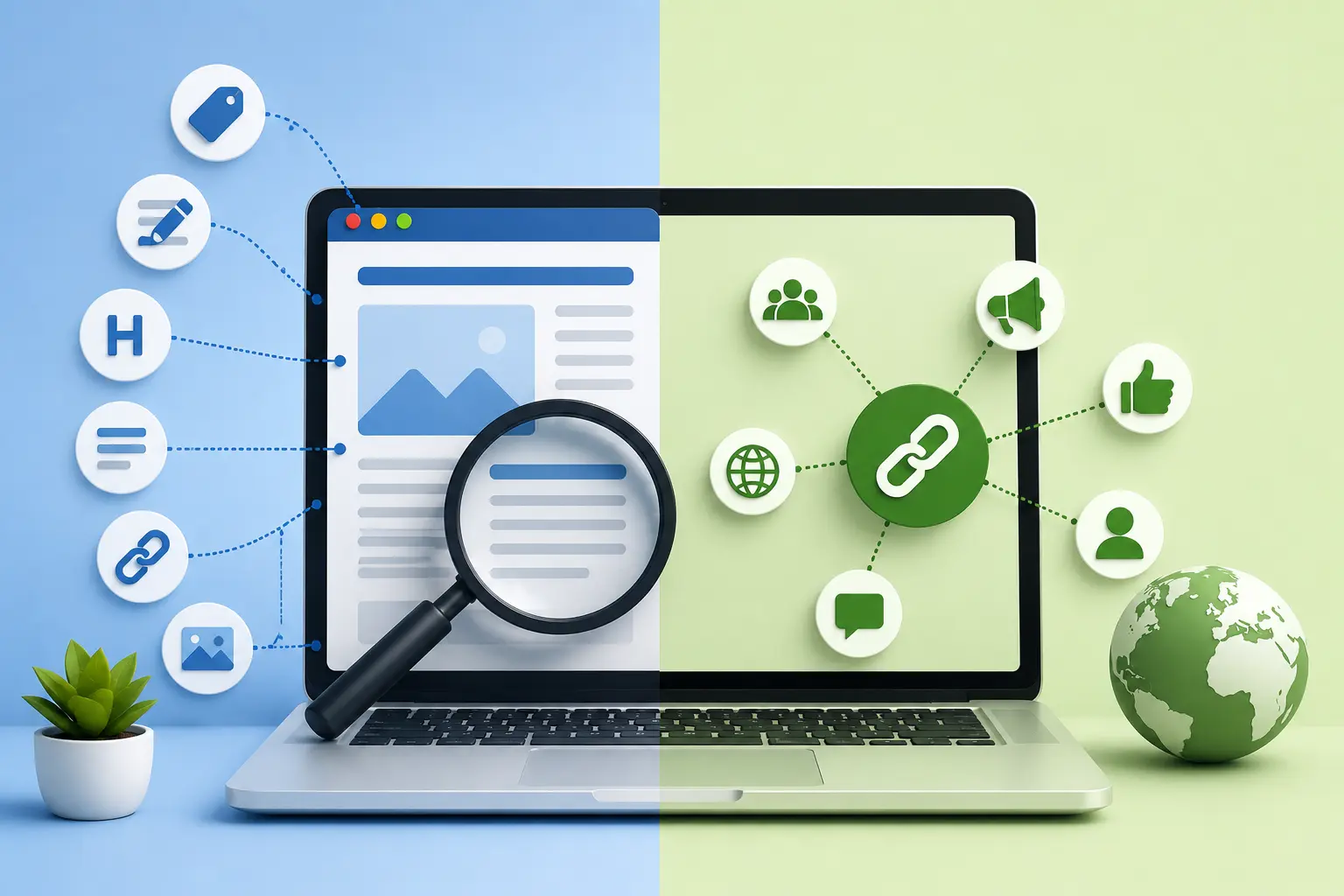
On-Page SEO focuses on optimizing elements within your website, while
Off-Page SEO focuses on activities outside your website that help build authority and credibility.
In this guide, we'll explain the difference between On-Page SEO and Off-Page SEO, what each includes, and why your website needs both.
What Is On-Page SEO?
On-Page SEO is the process of optimizing individual pages on your website to help search engines understand your content and provide a better experience for visitors.
It focuses on elements that you can directly control on your website.
Important On-Page SEO factors include:
SEO title
Meta description
Headings
Keyword optimization
Content quality
Internal linking
URL structure
Image optimization
Alt text
Page speed
Mobile responsiveness
Schema markup
The main goal is to make your website useful, relevant, easy to understand, and easy for search engines to crawl.
If you want professional help optimizing these elements, you can explore our
SEO services, which include On-Page SEO optimization, keyword research, technical SEO, internal linking, and more.
What Is Off-Page SEO?
Off-Page SEO refers to activities performed outside your website to improve its authority, reputation, and visibility in search engines.
Backlinks are one of the most important parts of Off-Page SEO. A backlink is a link from another website pointing to your website.
Common Off-Page SEO activities include:
Link building
Digital PR
Brand mentions
Guest contributions
Content promotion
Industry outreach
Relevant directory listings
Relationship building
The goal is to build your website's reputation and demonstrate that other relevant sources recognize your content or business.
On-Page SEO vs Off-Page SEO: Key Difference
The easiest way to understand the difference is:
On-Page SEO = Optimizing your own website
Off-Page SEO = Building authority outside your website
For example, optimizing a service page's title, headings, content, images, and internal links is On-Page SEO.
Getting a relevant and trustworthy website to link to that service page is Off-Page SEO.
On-Page SEO vs Off-Page SEO Comparison
On-Page SEO Off-Page SEO
Focuses on your website Focuses on activities outside your website
Content optimization Link building
SEO titles and headings Digital PR
Internal linking Brand mentions
Image optimization Content promotion
Technical improvements Authority building
Both strategies work toward the same overall goal: improving your website's visibility and helping it compete in search results.
Why Is On-Page SEO Important?
On-Page SEO helps search engines understand what your pages are about and whether they are relevant to a user's search.
For example, if you have a page about
SEO services, proper keyword targeting, useful content, descriptive headings, internal links, and optimized metadata can help search engines better understand that page.
Good On-Page SEO can also improve the user experience because visitors can find the information they need more easily.
Why Is Off-Page SEO Important?
Off-Page SEO helps establish your website's authority and reputation.
High-quality backlinks from relevant and trustworthy websites can act as valuable signals that your content is worth referencing.
However, Off-Page SEO is not simply about getting as many backlinks as possible.
Quality, relevance, and natural link acquisition are more important than the number of links.
Which Is More Important: On-Page SEO or Off-Page SEO?
There is no need to choose only one.
On-Page SEO and Off-Page SEO work together.
You can build hundreds of backlinks, but if your website has poor content, technical problems, or a bad user experience, those links may not produce the results you expect.
Similarly, you can create excellent content and optimize your website properly, but competing for highly competitive keywords can be difficult without building website authority.
A balanced SEO strategy should therefore include both.
How to Improve Your On-Page SEO
Start with the fundamentals:
Research relevant keywords
Create useful and original content
Optimize SEO titles and meta descriptions
Use clear H1, H2, and H3 headings
Improve internal linking
Optimize images and alt text
Use clean and descriptive URLs
Improve page speed
Make pages mobile-friendly
Add relevant structured data
Always optimize for users first instead of adding keywords unnaturally.
Your website's technical foundation also matters. If your website requires custom technical improvements, you can explore our
web development services for custom websites, CMS development, APIs, and performance-focused web solutions.
How to Improve Your Off-Page SEO
A sustainable Off-Page SEO strategy can include:
Creating link-worthy content
Digital PR
Building relationships with relevant websites
Promoting useful resources
Earning industry mentions
Getting relevant backlinks
Building your brand's online presence
Avoid buying large numbers of low-quality backlinks or using manipulative link schemes. These approaches can create long-term SEO risks.
For businesses that want to combine SEO with a broader online growth strategy,
digital marketing services can help connect SEO with other online marketing activities.
Why Website Design Also Matters for SEO
SEO is not only about keywords and backlinks. Your website's structure, usability, mobile responsiveness, and user experience also matter.
A well-designed website can make it easier for visitors to navigate your content and find the information they need.
Professional
website design services can help create a responsive and user-friendly website that provides a strong foundation for SEO.
On-Page SEO and Off-Page SEO for New Websites
If you have a new website, start with On-Page SEO and Technical SEO before focusing heavily on link building.
Make sure your website has:
A clear structure
Useful content
Proper keyword targeting
Fast loading pages
Mobile-friendly design
Search-friendly URLs
Internal links
Proper indexing
Once the foundation is strong, you can begin promoting your content and building relevant authority through Off-Page SEO.
How Long Does On-Page and Off-Page SEO Take?
SEO results vary from website to website.
On-Page SEO improvements can sometimes produce relatively quick changes, especially when a website has significant technical or content problems.
Off-Page SEO generally takes longer because earning quality backlinks and building authority requires time.
The overall timeline depends on factors such as:
Competition
Website age
Content quality
Domain authority
Backlink profile
Industry
Target keywords
SEO strategy
SEO is generally a long-term process rather than a one-time activity.
On-Page SEO vs Off-Page SEO: Which One Should You Start With?
For most websites, the best approach is to build a strong foundation first.
1. Technical SEO: Make sure search engines can crawl and index your website.
2. On-Page SEO: Optimize your content, keywords, headings, images, URLs, and internal links.
3. Off-Page SEO: Build relevant authority through quality backlinks, digital PR, and content promotion.
This creates a more complete SEO strategy instead of relying on a single technique.
How On-Page and Off-Page SEO Work Together
Think of your website as a business.
On-Page SEO makes your website useful, organized, and easy to understand.
Off-Page SEO helps build your website's reputation and authority.
For example, you could optimize your service pages with relevant keywords, useful content, proper headings, internal links, and optimized images. Then you could promote those pages and earn relevant backlinks from authoritative websites.
This combination creates a stronger SEO foundation.
Final Thoughts
The difference between
On-Page SEO and Off-Page SEO is simple: On-Page SEO focuses on improving your website, while Off-Page SEO focuses on building your website's authority outside of it.
Neither should be ignored.
A successful SEO strategy combines high-quality content, technical optimization, strong On-Page SEO, relevant Off-Page SEO, internal linking, and a positive user experience.
If you want to improve your website's organic visibility, you can
contact our SEO service team for a complete SEO strategy covering On-Page SEO, Off-Page SEO, Technical SEO, content optimization, and link building.
You can also
view our portfolio to see examples of our digital projects and
contact SA IT Solutions to discuss your SEO requirements.
Frequently Asked Questions
What is the difference between On-Page SEO and Off-Page SEO?
On-Page SEO focuses on optimizing elements within your website, while Off-Page SEO focuses on external activities such as link building, digital PR, and brand mentions.
Is On-Page SEO more important than Off-Page SEO?
Both are important. Strong On-Page SEO creates a solid website foundation, while Off-Page SEO can help build authority and credibility.
Are backlinks On-Page SEO or Off-Page SEO?
Backlinks are generally considered an important part of Off-Page SEO because they come from external websites.
Can I rank a website without backlinks?
Yes, it is possible to rank for some low-competition searches without many backlinks. However, competitive keywords often require stronger website authority.
Should I do On-Page SEO before link building?
Generally, yes. It is better to optimize your website and content first so that visitors arriving through search or backlinks find a useful and well-structured page.